
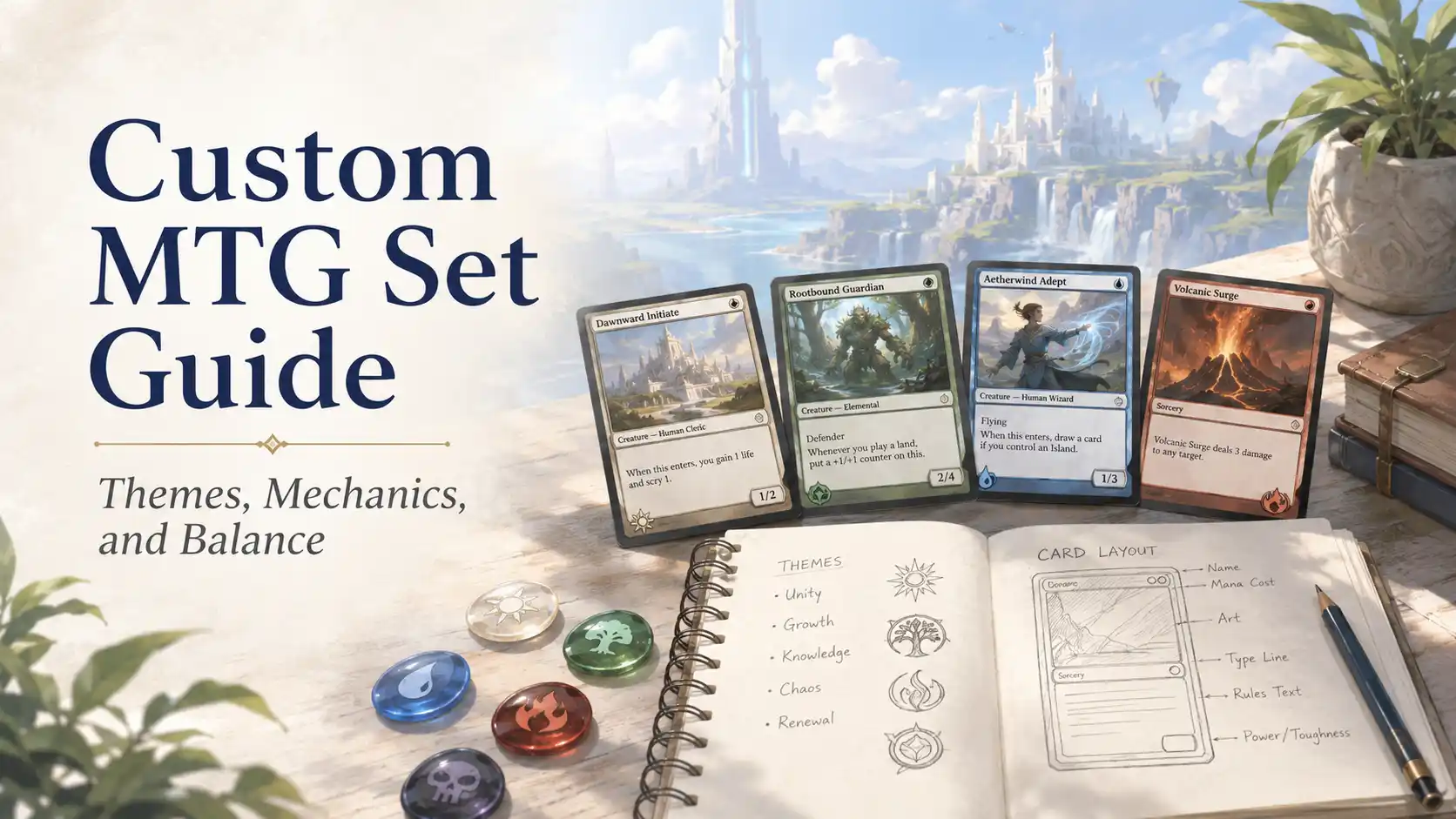
Creating a custom MTG set is one of those projects that sounds simple right up until you open a blank card file and realize you need lands, commons, archetypes, mechanics, removal, draft balance, flavor, names, tokens, and probably a spreadsheet you promised yourself you would not make.
A custom Magic: The Gathering set is more than a pile of cool card ideas. A good set feels like a place, a story, or a mechanical experiment that players can actually play. It has themes that hold the cards together, mechanics that create interesting decisions, and enough balance that one color pair does not steamroll the table while another sits there politely losing.
This guide walks through how to create a custom MTG set from the ground up, including theme, mechanics, set structure, color balance, Limited archetypes, rarity, playtesting, and final polish.
Every custom MTG set needs a clear center. This is the “what is this set about?” question.
A weak answer is something like, “It has dragons, artifacts, graveyards, pirates, snow, and a new mechanic where lands explode.” That might be fun for one card. It is not a set. It is a junk drawer with mana symbols.
A stronger answer is focused:
A gothic city where spirits and detectives fight over forbidden memories
A desert plane where survival, cycling, and graveyards matter
A war between five animal clans, each tied to a color pair
A magical academy built around spells, lessons, and rival houses
A sci-fi artifact world where creatures upgrade themselves
Your core idea should answer three things:
What is the world?
What kind of gameplay should it create?
What emotions should players feel?
A horror set should feel tense. A treasure set should feel greedy and explosive. A faction set should make players want to pick a side. A graveyard set should make the discard pile feel like a second hand, which is only slightly unsettling.
Before designing cards, decide the rough size of the set. You can always adjust later, but a target keeps the project from growing into a 900-card monument to poor planning.
For a small custom set, aim for around 100 to 180 cards. That is enough to build themes, test mechanics, and play casual sealed or cube-style games without designing every possible card type.
For a draftable set, you may want something closer to 250 cards, especially if you want commons, uncommons, rares, mythics, tokens, basic lands, and multiple archetypes.
A simple custom set structure might look like this:
101 commons
80 uncommons
60 rares
20 mythic rares
10 basic lands or special lands
10 to 20 tokens
You do not have to follow official Magic set structures perfectly. But you should understand what each rarity is supposed to do. Commons carry the Limited environment. Uncommons define archetypes. Rares and mythics create splashy build-arounds, finishers, and memorable moments.
The color pie is the heart of Magic design. It controls what each color is good at, what each color struggles with, and how the colors feel different from each other. Wizards’ Mechanical Color Pie article is a useful reference because it organizes abilities by primary, secondary, and tertiary color access, which is exactly the kind of guidance custom designers need when deciding where mechanics belong.
In custom set design, color pie mistakes are easy to make. Maybe blue gets efficient creature removal because it fits your story. Maybe green gets counterspells because the forest is “defending itself.” Maybe red gets lifegain because fire is warm. You can justify almost anything with enough flavor. That does not mean the game will play well.
A custom set can bend the color pie a little, but it should not break it casually. When every color can do everything, the colors stop mattering.
Ask these questions for each color:
What is this color’s main strategy in the set?
What does this color do well?
What does this color lack?
What mechanics does it share with other colors?
What kind of removal does it get?
What does its common creature curve look like?
The goal is not to be rigid. The goal is to make each color feel distinct.
Themes are the repeated ideas that show up across the set. They can be mechanical, flavorful, or both.
Mechanical themes include:
Artifacts matter
Graveyard recursion
Spellslinger
Creature tokens
Lands matter
Life gain
Counters
Sacrifice
Enchantments
Combat tricks
Card draw
Discard
Flavor themes include:
Ancient ruins
Monster hunters
Political intrigue
Elemental storms
City guilds
Ocean exploration
Dream magic
Mechanical themes are what players do. Flavor themes are why those actions feel connected. The best custom sets combine both.
For example, a haunted library set might have graveyard recursion, clues, card draw, and flashback-style effects. The mechanics support the theme of lost knowledge. That feels more coherent than just putting “haunted library” art on random unrelated cards.
Custom set designers often make too many mechanics. It is tempting. Mechanics are fun to invent. Unfortunately, a set with seven new mechanics usually becomes a rules soup.
Start with two or three major mechanics. Add one minor returning mechanic if needed.
A good set mechanic should be:
Easy to understand
Flexible across several colors
Useful at common
Interesting in multiples
Connected to the world
Balanced in Limited
A mechanic that only works on rares is not really a set mechanic. It is a rare-card gimmick. A mechanic that requires five lines of reminder text on every card is probably too complex. A mechanic that creates tracking problems every turn might be fun once and annoying forever.
Wizards’ keyword glossary is a helpful place to look at how established mechanics are explained in simple terms. Studying existing keyword wording can help you write custom mechanics that look and read more like real Magic cards.
Each mechanic should create a different kind of decision. If all three mechanics reward attacking, the set may become one-note. If every mechanic uses the graveyard, games may blur together.
A stronger set might include:
One combat mechanic
One resource mechanic
One graveyard or card-advantage mechanic
For example:
Valor: rewards attacking with multiple creatures
Harvest: creates Food or mana from lands
Echoform: casts or copies cards from the graveyard
These mechanics point players in different directions while still belonging to the same world. That gives the set texture.
Also, make sure mechanics interact. If one archetype creates tokens, another sacrifices permanents, and another rewards creatures entering the battlefield, those strategies can overlap naturally.
If the set is meant to be drafted or played in sealed, build the Limited archetypes before designing too many individual cards.
Most modern sets use ten two-color archetypes as a starting point. You do not have to, but it is a useful structure. Each color pair gets a theme that players can discover during draft.
Example archetype grid:
White-blue: flying tempo
Blue-black: graveyard control
Black-red: sacrifice aggro
Red-green: power matters
Green-white: creature tokens
White-black: life drain
Blue-red: spellslinger
Black-green: recursion
Red-white: go-wide attacks
Green-blue: ramp and card draw
Once you have archetypes, design signpost uncommons for each pair. These are the cards that tell drafters what the color pair is doing. A white-blue uncommon that rewards flying creatures sends a clear signal. A black-red uncommon that sacrifices artifacts for damage tells players exactly where to go.
Without archetypes, your draft format becomes a pile of cards that technically function but do not guide the player. That is less “custom set” and more “bulk rare box with ambition.”
Commons are the foundation of the set. They decide how games actually play. Rares may be flashier, but commons define the speed, removal, board stalls, combat, and draft experience.
Design common cards for each color before you get lost in mythics. Each color should have:
Small creatures
Midrange creatures
A large creature or finisher
Removal or interaction
A combat trick or utility spell
A card advantage tool
A way to support the set mechanic
A simple archetype payoff
Commons should not all be exciting. Some need to be glue cards. A clean two-mana creature can do more for the format than a wordy rare with six triggered abilities and a superiority complex.
When testing, pay special attention to common removal. If removal is too weak, bombs dominate. If removal is too strong, creatures feel pointless. If one color has all the good removal, everyone drafts that color and the format gets boring fast.
Uncommons are where you can be more specific. They should reward players for noticing themes.
A good uncommon might say:
Draft lots of artifacts
Play creatures with flying
Put cards in your graveyard
Go wide with tokens
Cast two spells in one turn
Gain life repeatedly
Uncommons are also great places for build-arounds. They do not need to win alone, but they should make players think, “I can build around this.”
For a custom set, uncommons are your teaching layer. They show players what the set wants them to do without needing a design essay stapled to the booster pack.
Rares and mythics should create excitement, but they should not ruin games too often. There is a difference between a powerful rare and a card that makes everyone groan.
Good rares:
Create a memorable moment
Reward a deckbuilding choice
Give players a reason to try a theme
Are strong but answerable
Fit the set’s world and mechanics
Bad rares:
End the game with no counterplay
Ignore the set’s themes
Create repetitive board locks
Make Limited games feel predetermined
Are confusing just to look clever
Mythics can be bigger and stranger, but they still need to play well. A custom mythic should feel special, not like the designer got into a fight with restraint and restraint lost.
Custom cards feel much better when they use Magic-style wording. The official Comprehensive Rules are the full reference for how the game works, although Wizards notes that the document is meant to be consulted for specific rules questions rather than read start to finish.
For normal custom set writing, you do not need to become a rules lawyer. You do need to use consistent phrasing.
Use real cards as templates. If you are making a “draw two cards” spell, look at existing draw spells. If you are making a sacrifice trigger, look at existing sacrifice triggers. If you are making a counterspell variant, study how counterspells are worded.
Scryfall is useful for this because its API and search tools expose card data and make it easy to find existing examples by wording, color, type, and mechanic.
Do not invent wording unless you have to. Magic has already solved many templating problems. Borrow the clean solutions.
A custom set needs a playable curve. If every cool creature costs five mana, the early turns will be empty. If all the strongest cards cost two mana, games may end before the set’s bigger themes matter.
Each color should have a reasonable spread of creatures and spells across the curve.
For Limited, pay close attention to:
One and two-mana creatures
Three-mana stabilizers
Four-mana value creatures
Five-plus mana finishers
Instant-speed interaction
Combat tricks
Mana fixing
Too much fixing can make every deck five colors. Too little fixing can make multicolor themes unplayable. The right amount depends on the set’s goals.
If your set has factions or three-color themes, you need more fixing. If your set is mostly mono-color or two-color, fixing can be lighter.
A common custom design mistake is testing only the exciting cards. But real sets include filler, sideboard cards, simple commons, and narrow effects. You need to know how the whole environment plays, not just the highlight reel.
Run test drafts or sealed pools with the full card file. See what people actually pick. Watch which colors are ignored. Notice which mechanics confuse players. Track which cards never get cast.
Do not defend a card just because you love it. If every tester misreads it, the card probably needs rewriting. If every game involving one rare becomes miserable, the card needs changing. If a mechanic is “really cool once explained,” that may mean it is not clear enough on the card.
Playtesting is where the set gets honest. Unfortunately, honesty often comes with red pen.
Custom sets often become too complex because the designer knows every card already. New players do not.
Complexity shows up in several ways:
Too many mechanics
Too much tracking
Too many counters
Too much modal text
Too many triggered abilities
Too much graveyard checking
Too many custom terms
A set can have depth without making every card complicated. Commons should be clean. Uncommons can carry more detail. Rares can be splashy. Mythics can be weird. That distribution helps players learn the set gradually.
If a common has more text than a tax form, simplify it.
If your set uses tokens, counters, emblems, day/night-style tracking, dungeons, roles, or custom markers, design those pieces early.
Tokens should include:
Name
Type line
Color
Power and toughness
Keyword abilities
Rules text if needed
Set symbol or custom mark
Helper cards are also useful for custom mechanics. If your set has a new status, counter type, dungeon, or emblem-like effect, a reminder card can make games smoother.
Do not wait until the end to discover that your set creates eight token types and three of them are almost identical. That is how board states become soup.
A custom set should feel like a world. Mechanics are the skeleton, but names, art direction, creature types, flavor text, and color identity give it personality.
Create a simple world guide:
Plane name
Major locations
Main factions
Important characters
Creature types
Magic sources
Conflict
Tone
Visual style
Then make card names reflect that world. A set about sky pirates should not have generic names like “Big Dragon” and “Counter Spell Guy.” Well, maybe one joke card. But not the whole file.
Flavor text should add mood without crowding the card. It is optional, especially if the rules text is already long.
Once the design works, decide how the set will look. You might use a standard Magic-style frame, full art templates, custom card frames, or simplified proxy layouts.
Before printing, check:
Card size
Bleed
Safe margins
Text readability
Image resolution
PDF setup
Token layout
Card backs
Proxy or fan-made markings
If the set uses Magic-inspired material, be careful about presentation and use. Wizards’ Fan Content Policy covers fan-created material based on Wizards IP and sets conditions around use, including avoiding claims of official status or endorsement.
For casual personal use, clear custom or proxy markings are a good habit. Do not try to pass custom cards off as official cards. Your set should feel polished, not deceptive.
Before calling the set finished, check the basics:
Clear world concept
Defined set size
Two or three major mechanics
Color pie respected
Ten or fewer main archetypes
Commons support real gameplay
Uncommons signal draft themes
Rares are exciting but answerable
Mana curve is healthy
Removal is balanced
Fixing matches the format
Tokens and helper cards are included
Rules text uses real Magic templating
Playtests have been run
Cards have been revised
Print files are readable and properly sized
That checklist will not make the set perfect, but it will prevent many of the usual custom design disasters.
Creating a custom MTG set is part game design, part worldbuilding, part editing, and part learning to delete cards you were emotionally attached to. The best custom sets are not just collections of clever designs. They have a clear theme, a playable structure, mechanics that reinforce the world, and enough balance to make games interesting more than once.
Start small. Build the world. Choose a few mechanics. Design commons early. Give each color pair a reason to exist. Playtest before polishing. Then revise until the set feels like one coherent experience instead of a folder full of unrelated cool ideas.
A strong custom Magic set should make players want to draft it, build with it, and ask what the next set on that plane would look like. That is the real win.