Custom MTG Rarity: Commons, Uncommons, Rares, and Mythics

Choose a custom card’s rarity by considering how often it should appear, what it asks players to understand, and how it affects the surrounding environment.

Choose a custom card’s rarity by considering how often it should appear, what it asks players to understand, and how it affects the surrounding environment.
PrintMTG offers the more direct workflow for MTG-focused cards, while MakePlayingCards provides broader control over materials, formats, packaging, and production options.
A design-to-print workflow for creating clearly unofficial alternate-art MTG playtest cards with sharp artwork, readable text, safe crops, and reliable sizing.

A design-first workflow for turning custom or alternate artwork into clear, readable unofficial Magic-style cards that survive card-size review and printing.
Commons establish the repeated gameplay of a custom Limited set. Build and test them first to expose problems with pacing, interaction, themes, and complexity before higher rarities hide those weaknesses.
Reality Fracture’s abandoned color-shifted concepts reveal a valuable custom-card rule: preserve the recognizable role, but rebuild the effect using the new color’s own tools and weaknesses.
Design a custom Magic-style Saga with a coherent story arc, rules-aware chapter timing, readable layout, and a practical playtest plan.
Reality Fracture offers custom-set designers a two-layer model for Limited overlap: broad per-color themes do the structural work, while shared Cadet tokens create visible bridges between otherwise distinct archetypes.
A practical revision system for tracking custom card versions, collecting contextual playtest evidence, and deciding what to keep, revise, retest, or cut.
Design a reusable MTG copy token that clearly separates the copied permanent’s identity from counters, status, attachments, and other changing battlefield information.
Set up custom Magic-style card files correctly with practical dimensions for trim size, raster resolution, bleed, safe areas, and print handoff.
Empower Jace shows how a demanding mechanic can justify its complexity by carrying a set’s story, recurring play pattern, and visual identity.
A repeatable method for testing a fan-made Limited set, from pack setup and digital simulations to human drafts, gameplay notes, and focused revisions.

Learn how bleed, trim lines, safe areas, and crop zones work when preparing a custom Magic-style card file for export or printing.
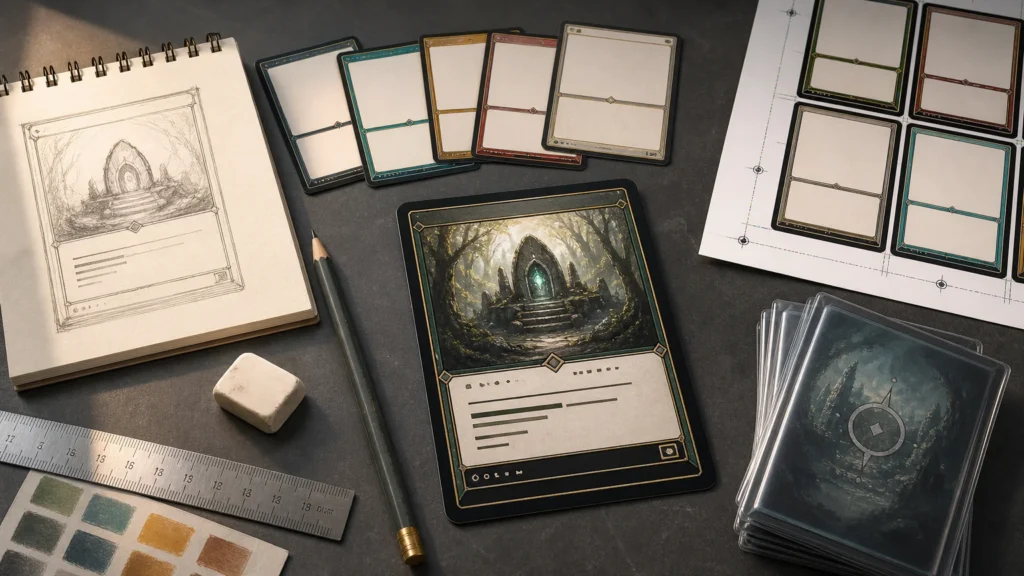
Turn a card idea into a clear, playable custom Magic-style design with this practical workflow for mechanics, wording, layout, review, and playtesting.