
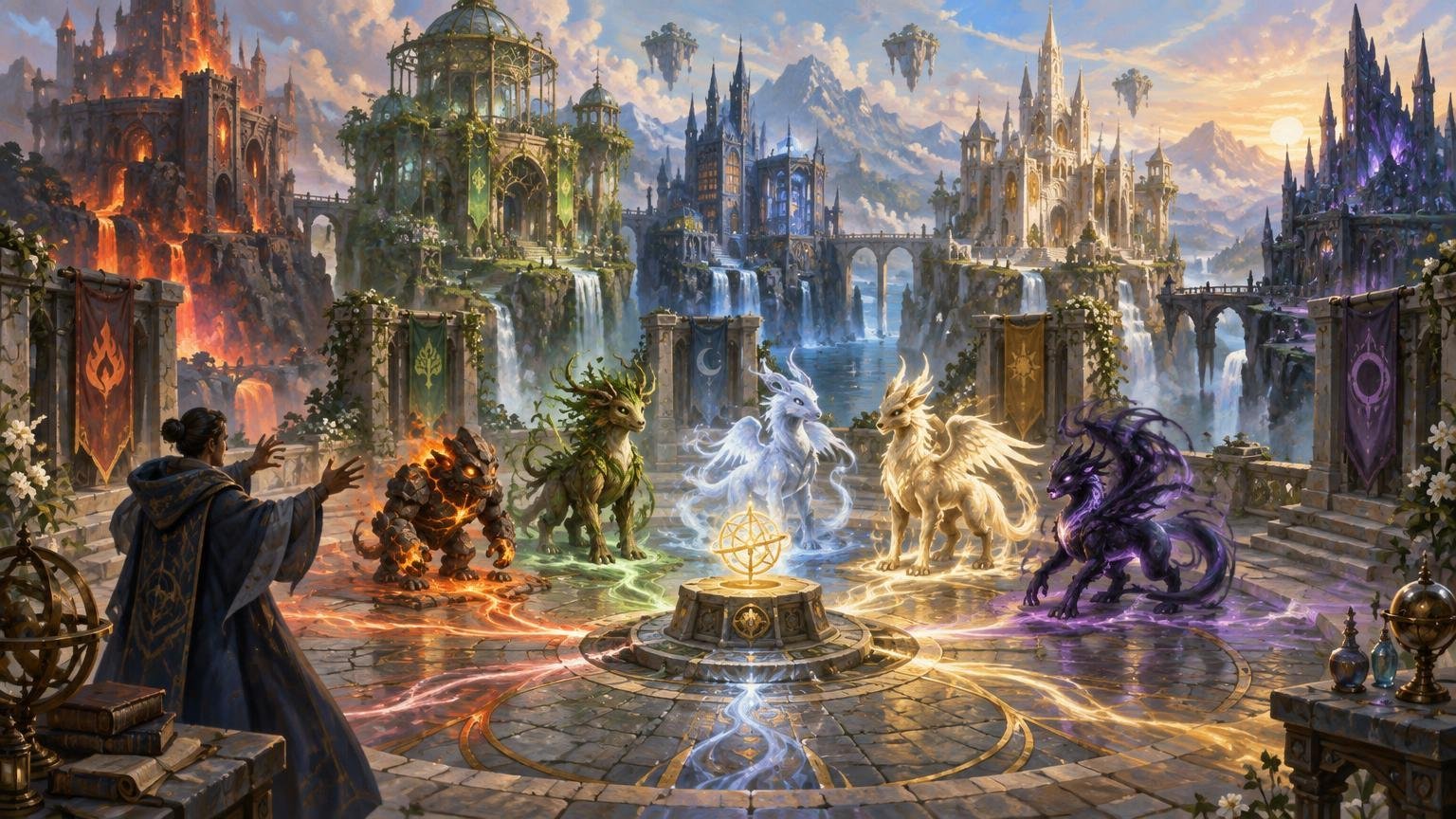
Reality Fracture’s most useful Limited-design idea is not simply that five Hexhaven schools share Cadet tokens. The deeper structure gives each color a broad mechanical job that supports two different color pairs. Cadets then add a narrower layer of shared material. For a custom set, copy that order: establish flexible monocolor foundations first, build distinct pair-specific rewards second, and add a shared token only if different decks genuinely use it in different ways.
If you reduce the Reality Fracture Hexhaven ally color draft archetypes Cadets discussion to “every school makes the same creature token,” you miss the stronger lesson. Shared objects can help a Draft environment overlap, but they cannot carry the environment alone. The connective tissue underneath Hexhaven is a color-based grid designed to give cards multiple homes without making all ten two-color decks feel interchangeable.
That distinction matters for custom-set designers because mechanical silos are seductive. It is easy to invent ten flavorful archetypes, give each one a named mechanic, and discover during Draft that every card has exactly one destination. Reality Fracture points toward a healthier model: broad enablers at the color level, recognizable payoffs at the color-pair level, and a carefully limited amount of shared vocabulary across the set.
Wizards published Mark Rosewater’s second Reality Fracture vision-design handoff on September 28, 2026. The document describes the Hexhaven colleges as flavor for the five ally-color Draft archetypes, not as factions consuming the entire set. Its shared Cadet concept was part of that vision-stage plan. Read the official Vision Design handoff for the historical design context.
The published Prerelease Guide identifies ten two-color archetypes in the release environment: five ally-color Hexhaven schools and five enemy-color strategies associated with major characters. The Hexhaven decks are white-blue surveil aggro, blue-black graveyard and threshold, black-red face burn, red-green mana ramp, and green-white life gain.
Set Design lead Yoni Skolnik’s account supplies the more important structural detail. Each color was assigned a core theme intended to contribute to two color pairs: one ally-color Hexhaven deck and one enemy-color character deck. Skolnik explains that this baseline overlap let similar cards support multiple payoffs while leaving room for synergy cards, generically useful cards, and sideways strategies.
| Color | Published base theme | What it contributes to a custom set |
|---|---|---|
| White | +1/+1 counters | A reusable progression system that can reward attacking, token production, or creature growth without naming one exact deck. |
| Blue | Empowering Jace | A set-specific focal activity that can connect multiple strategies when its supporting cards also perform ordinary game functions. |
| Black | Graveyard play | Resources entering or leaving the graveyard can feed more than one payoff package. |
| Red | Prowess and noncreature spells | Cheap spells and spell-sensitive creatures can serve aggressive and value-oriented decks differently. |
| Green | Big mana or big creatures | Ramp, mana sinks, and substantial bodies can support several endgames rather than one scripted combination. |
These themes do not make the archetypes identical. They define what a color contributes before its partner changes the meaning of that contribution. That is the critical design move. A black card that mills, recurs, or benefits from the graveyard can belong in blue-black without being unusable elsewhere. A red noncreature spell can trigger one deck’s spell payoff while still functioning as interaction or reach in another.
For designers building a file from scratch, this color-first work belongs early in the process described in our guide to creating a coherent custom MTG set. Pair signposts are useful, but the commons underneath them determine whether a Draft actually contains decisions.
The Cadet plan is still a smart and unusually legible example. Rosewater’s handoff describes all five schools creating the same 2/2 colorless Cadet creature token, with each college interacting with that game piece differently. The alternative would have been five separate school mascots. Standardizing the token reduced the number of token identities players would need to recognize while preserving room for school-specific rewards.
Reality Fracture’s release notes confirm Cadet as the name of a 2/2 colorless Wizard Soldier creature token and identify multiple Cadet-creating cards, including Germinate Recruits, Ajani Unrelenting, and Craftwork Crusher. The Prerelease Guide also calls Cadet makers useful bodies for the red-white Ajani’s Army aggressive strategy, showing that the shared piece can matter outside the five ally-color schools.
That does not prove every college uses Cadets equally, nor does it establish that Cadets define the released format. The handoff is a record of an earlier design plan, while the release notes and Prerelease Guide show selected final implementations. There is no supplied Draft data establishing win rates, player reception, or how often Cadet cards move between archetypes.
What the evidence does establish is a valuable construction pattern. One familiar game piece can appear in several contexts without demanding a new token type for each context. A green-white deck might care about gaining value from a wide battlefield, while a white-blue deck could use the same bodies to enable attacks or counters. The token remains simple; the surrounding cards create the identity.
This is also a visual-design advantage. If multiple cards create the same token, players only need one consistent name, type line, power and toughness, and token treatment. Designers still need to ensure the token reads quickly at final size; our custom Magic token design guide covers that presentation problem in more detail.
A practical custom-set workflow starts with a five-by-two support map rather than ten isolated pitch documents. Give each color one broad job that can combine with either neighboring strategy. Then make the color pairs distinct through rewards, pacing, and card valuation.
The objective is not to make every card equally desirable to every deck. That would flatten Draft signals and reduce archetype identity. The objective is to produce contested cards for understandable reasons. A cheap token maker might be premium in the dedicated go-wide deck, acceptable in a counters deck, and merely filler elsewhere. Those differences create decisions.
A shared token can look connective in a set skeleton while producing no meaningful overlap during play. Test the actual card flow. After each draft, ask where every shared enabler was selected, which payoff motivated the pick, and whether another deck could reasonably have wanted it at that point in the pack.
That final question is the strongest guardrail. Cadets are compelling because they can carry school flavor and provide bodies, but Hexhaven’s broader structure does not need them to explain every connection. The per-color themes already create the foundational overlap. Shared tokens sit on top of that scaffold instead of replacing it.
Do not add one merely because a common token makes the set diagram look elegant. If every archetype makes the same 2/2 and every payoff rewards controlling many creatures, the decks will converge on the same board state. Their names and gold cards may differ, but their games will not.
A shared token is also a poor bargain when every faction needs a bespoke exception: one changes its type, another changes its stats, a third grants an ability, and a fourth tracks a named status. At that point, the token is shared mostly in name. The supposed vocabulary saving has been spent on riders and memory burden.
Use separate tokens when differences in size, creature type, abilities, or battlefield purpose communicate information players genuinely need. Use no dedicated token when ordinary creature cards can perform the role with less tracking. Complexity is justified by the decisions it creates, not by how prominently it appears in the set pitch.
Reality Fracture was framed as a major capstone centered on a more personal Jace story rather than another increase in multiverse-wide narrative scope, with Hexhaven chosen as its single-plane setting. That narrower setting still had to support a ten-archetype Limited environment, and the published design material shows two complementary solutions: stable mechanical jobs for each color and a visible shared token concept for the schools.
Reality Fracture arrived on MTG Arena on September 29, 2026, with its worldwide tabletop release scheduled for October 2, 2026. It is therefore too early, based on the supplied evidence, to treat live Draft results as validation of the model. The design documents are useful because they expose the scaffold, not because they prove every implementation succeeded.
For your next revision, write each color’s base job beside the two archetypes it supports. Mark every common that has only one realistic home. Then ask whether a shared asset such as a Cadet token would create new choices or merely repeat an existing game plan. If the color grid works before the token is added, the token can become connective tissue. If the grid does not work, no mascot—however charming—will rescue the Draft environment.