
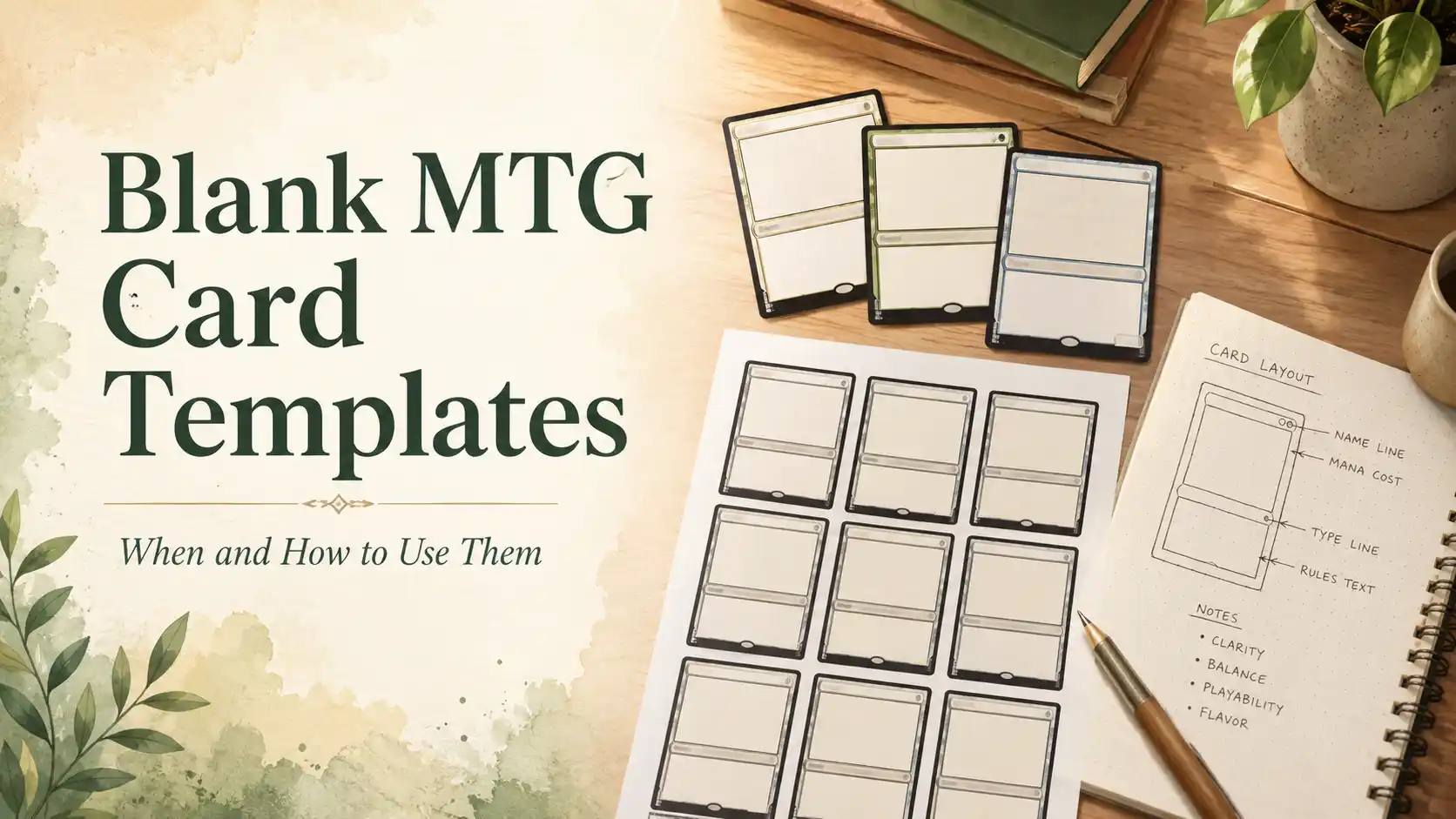
Blank MTG card templates are best for rough design, playtesting, fan-made cards, cube placeholders, teaching exercises, and custom tokens.
Use them when you need speed, flexibility, or a readable temporary card. Do not use them to create anything that could be mistaken for an authentic Magic card.
The best blank template is simple: card name, mana cost, type line, rules text, power and toughness if needed, and enough white space that your playgroup does not need a jeweler’s loupe.
Blank MTG card templates are the cardboard equivalent of a sketchpad. They let you test an idea before you spend time on art, frames, set symbols, styling, and all the other details that make a card look polished while still possibly playing like a raccoon wrote it at 2 a.m.
That is the real value. A blank template slows you down just enough to ask the useful questions. What does the card do? What does it cost? What type is it? How much text does it need? Is it actually fun? Can a human read it?
The art can come later. The frame can come later. The dramatic title can come later. First, make sure the card works.
A blank MTG card template is a simplified card layout used to draft, test, or print custom Magic-style cards. It usually leaves empty spaces for the card’s core parts:
Card name
Mana cost
Card type and subtype
Rules text
Flavor text, if needed
Power and toughness
Loyalty, if needed
Set code or project label
Notes for testing
It can be digital or physical. Some players use printable sheets. Some use index cards. Some use card-sized slips of paper sleeved over basic lands. Some use spreadsheets, because apparently they want their fantasy hobby to feel like quarterly reporting.
All of these can work.
The point is not visual perfection. The point is fast iteration.
Blank templates are most useful when the design is still changing. If you are not sure whether a card should cost three mana or four, do not spend an hour finding perfect art. Use a blank template, test it, and let reality ruin your confidence the efficient way.
Use blank templates for:
Early custom card design
Fan-made sets
Commander house-rule cards
Cube test cards
Temporary proxies
Custom tokens
Teaching new players card anatomy
Playtest versions of expensive cards
Alternate wording tests
Custom mechanics
Blank templates are especially good when you expect to revise the card multiple times. If a card is still in the “what if this also made Treasure?” stage, it does not deserve a finished frame yet. It deserves a pencil and supervision.
Blank templates are not always the best choice.
Do not use a blank template when:
You need polished cards for repeated long-term play.
The table needs fast visual recognition.
The card has complicated rules text that needs careful formatting.
You are trying to match a full deck aesthetically.
The card will be used in a cube draft with unfamiliar players.
The design is stable enough to print cleanly.
For stable cards, a more finished proxy or custom card layout is easier to read and more pleasant to play with. ProxyKing’s guide to printing MTG proxies is a better route when you want a cleaner finished playtest card or full-deck proxy workflow.
Blank templates are for drafts. Finished templates are for cards you plan to keep using.
A good blank template should follow the same basic reading order as a real Magic card. Wizards’ own card anatomy guide breaks down major card elements like the name, mana cost, illustration, type line, text box, and power/toughness box, which is useful because Magic players already know where to look for those things. Do not make them hunt. Nobody has ever said, “I loved that custom card because the mana cost was hidden under the art.”
A practical blank template should include:
| Section | Purpose |
|---|---|
| Name line | Identifies the card |
| Mana cost box | Shows casting cost |
| Art or sketch space | Optional visual reference |
| Type line | Defines card type and subtype |
| Rules text box | Explains what the card does |
| Flavor or notes area | Optional design notes |
| Power/toughness box | For creatures |
| Loyalty box | For planeswalkers |
| Footer | Version number, creator note, or project label |
The card can look simple. In fact, it probably should. The more decorative the blank template becomes, the less “blank” it is. Funny how words work.
If you plan to print blank MTG card templates and sleeve them, use the standard trading card footprint:
2.5 inches wide
3.5 inches tall
At 300 DPI, that is:
750 pixels wide
1050 pixels tall
That size fits standard card sleeves when trimmed correctly. If you are using paper inserts, sleeve the printed template in front of a basic land or bulk card. Paper alone does not shuffle like a card. It flops, shifts, and generally behaves like it has no respect for the format.
For a sheet of templates, a 3-by-3 grid gives you 9 card-sized blanks per US letter or A4 page. This is the usual layout because it makes efficient use of the page without requiring card-sized origami.
Blank templates are excellent for custom Magic card design because they force you to write the actual card before decorating it.
Start with the simplest version:
Card name
Mana cost
Type line
One main ability
Stats, if needed
Then test it.
Example rough draft:
Name: Emberfield Scout
Mana Cost: 1R
Type: Creature, Goblin Scout
Text: Whenever Emberfield Scout attacks, exile the top card of your library. You may play it this turn.
Power/Toughness: 2/1
That is enough for a first test. You do not need art. You do not need flavor text. You do not need a showcase treatment called “goblin tax season foil.” You need to know whether the card plays well.
Once the design survives a few games, then you can move it into a polished card maker or finished proxy layout.
Cube designers should love blank templates because cube design is constant revision wearing a nice hat.
A blank template is useful when you want to test:
A new archetype signpost
A custom draft card
A nerfed version of a powerful card
A powered-down replacement for an expensive staple
A custom land cycle
A balance patch for your environment
A temporary card before ordering a cleaner proxy
The big advantage is speed. If a card does not work, toss it, revise it, or write over it. No emotional damage. Well, less emotional damage.
For cube play, readability matters more than beauty. A cube draft already asks players to evaluate many cards quickly. If your blank template is too messy, drafters will skip it because they do not want homework in pack two.
Tokens are one of the best uses for blank templates.
A token template can be very simple:
Token name
Color
Creature type
Power and toughness
Keyword abilities
Quantity reminder
Examples:
Treasure
Clue
Food
1/1 white Soldier
2/2 black Zombie
3/3 green Beast
Copy token
Monarch reminder
Initiative reminder
Custom tokens do not need full card formatting. They need to be clear during play. If your deck makes six different tokens, blank templates can keep the board state from turning into a pile of dice, snack wrappers, and one suspiciously important upside-down Swamp.
Blank MTG card templates are also useful for teaching new players how cards work.
You can use them to explain:
Where the card name goes
How mana costs work
What card types mean
What the type line does
How rules text is read
What power and toughness mean
How keywords change gameplay
Why the text box is not a suggestion
Teaching with a blank card is often easier than starting with a real card full of mechanics. A new player does not need to learn banding, protection, replacement effects, and the history of Oracle text in one sitting. Let them have peace.
Blank templates can work as temporary MTG proxies when you want to test a deck before buying or ordering cards. The important word is temporary.
For a proxy playtest card, include:
Exact card name
Mana cost
Card type
Current rules text or a clear shorthand
Power and toughness, if needed
A note that it is a proxy or test card
If you are checking current wording, Scryfall is useful for card names, Oracle text, printings, and card details.
For casual proxy use, be transparent before the game starts. ProxyKing’s Proxy Use Policy makes the casual-use boundary clear: proxies are for kitchen table Magic, playtesting, Commander nights where everyone agrees, cubes, private groups, and unsanctioned events where the organizer allows them. They are not for sanctioned play, deception, fraud, or being weird at a trade binder.
You can use blank templates digitally or physically.
| Template Type | Best For | Tradeoff |
|---|---|---|
| Digital template | Clean editing, easy revision, remote sharing | Requires software |
| Printable template | Fast table testing, handwriting, easy cutting | Messier and less polished |
| Dry-erase card sleeves | Reusable playtesting | Can smudge |
| Index card slips | Cheapest option | Less card-like |
| Full custom card maker | Polished final design | Slower to revise |
Digital templates are best when you are designing a full set or want clean versions. Printable templates are better when you need to test fast. Dry-erase options are excellent for repeated revisions, although they do carry the thrill of accidentally wiping your commander mid-game.
For most blank MTG card templates, use these fields:
Card Name:
Mana Cost:
Color:
Card Type:
Subtype:
Rules Text:
Power/Toughness:
Rarity:
Version:
Notes:
That is enough for design work. You do not need every official card component unless the card is near final.
For fan-made sets, add:
Set code
Collector number
Artist placeholder
Mechanic tag
Limited archetype
Design notes
Playtest rating
The more structured your template, the easier it is to revise later. Future you will appreciate this. Future you is tired.
Blank templates expose one of the most common custom card design problems: too much text.
If your rules text does not fit in a normal-sized text box, consider:
Removing flavor text
Cutting a secondary ability
Using an existing keyword
Breaking the design into two cards
Moving complexity to an activation cost
Removing cute text that does not affect gameplay
A custom card with four abilities is not automatically deep. Sometimes it is just four shallow cards trapped in one rectangle.
A good blank template should make overcrowding obvious early. That is a feature, not a flaw.
When testing custom cards, use version numbers.
Example:
Emberfield Scout v1
Emberfield Scout v2
Emberfield Scout v3
Version labels help you remember what changed. Without them, you will eventually stare at three similar slips and ask which one was “the balanced one.” The answer will be none of them, but at least version labels make the investigation shorter.
Track changes like:
Mana cost changed from 1R to 2R
Trigger limited to once each turn
Power reduced from 3 to 2
Ability changed from draw to impulse draw
Token changed from 2/2 to 1/1
If you are designing a fan set or custom cube, version control is not optional. It is how you avoid arguing with your own handwriting.
Blank templates should be clear casual tools. Do not make them look like authentic Magic cards. Do not use them to misrepresent cards. Do not bring them to sanctioned events and act surprised when the answer is no.
A responsible blank template can include:
“Playtest Card”
“Custom Card”
“Proxy”
“Fan-Made”
“Not for sanctioned play”
A custom project logo instead of official marks
That may seem obvious, but the obvious thing is usually the thing that prevents the awkward conversation later.
Before using a blank MTG card template, check:
The card is standard size if printing.
The name line is large enough.
The mana cost is easy to see.
The type line is clear.
The rules box has enough room.
Stats are included for creatures.
Loyalty is included for planeswalkers.
The template is readable in a sleeve.
The card is marked as custom, proxy, or playtest if needed.
The group knows what the card is before the game starts.
If the card fails the readability test, simplify it. If it fails the social test, do not play it. This is the glamorous discipline of not making the game worse.
Blank MTG card templates are used for custom card design, fan-made sets, playtest proxies, cube testing, tokens, teaching, and early card ideas that are still changing.
Use the standard trading card size of about 2.5 inches by 3.5 inches. At 300 DPI, that is 750 x 1050 pixels.
Yes, for casual playtesting where proxies are allowed. Include the card name, mana cost, type line, and readable rules text, and tell the table before the game starts.
No. Blank templates are often better without art during early design because they keep the focus on mechanics, cost, and readability.
No. Blank templates, custom cards, and player-made proxies are not legal in sanctioned Magic events. They are casual tools for testing, teaching, and fan-made play.
Use a blank template while the card is changing. Use a full card maker when the design is stable and you want a cleaner finished version.
Wizards of the Coast, “Anatomy of a Magic Card.” Used for standard card element context, including name, mana cost, illustration, type line, text box, and power/toughness.
Wizards of the Coast, “Fan Content Policy.” Used for fan-made content context and unofficial project boundaries.
ProxyKing, “Proxy Use Policy.” Used for responsible casual proxy use, playtesting, Commander, cube, and anti-misrepresentation guidance.
Scryfall, Advanced Search and card search tools. Used for card name, Oracle text, printing, and card-detail checking context.