
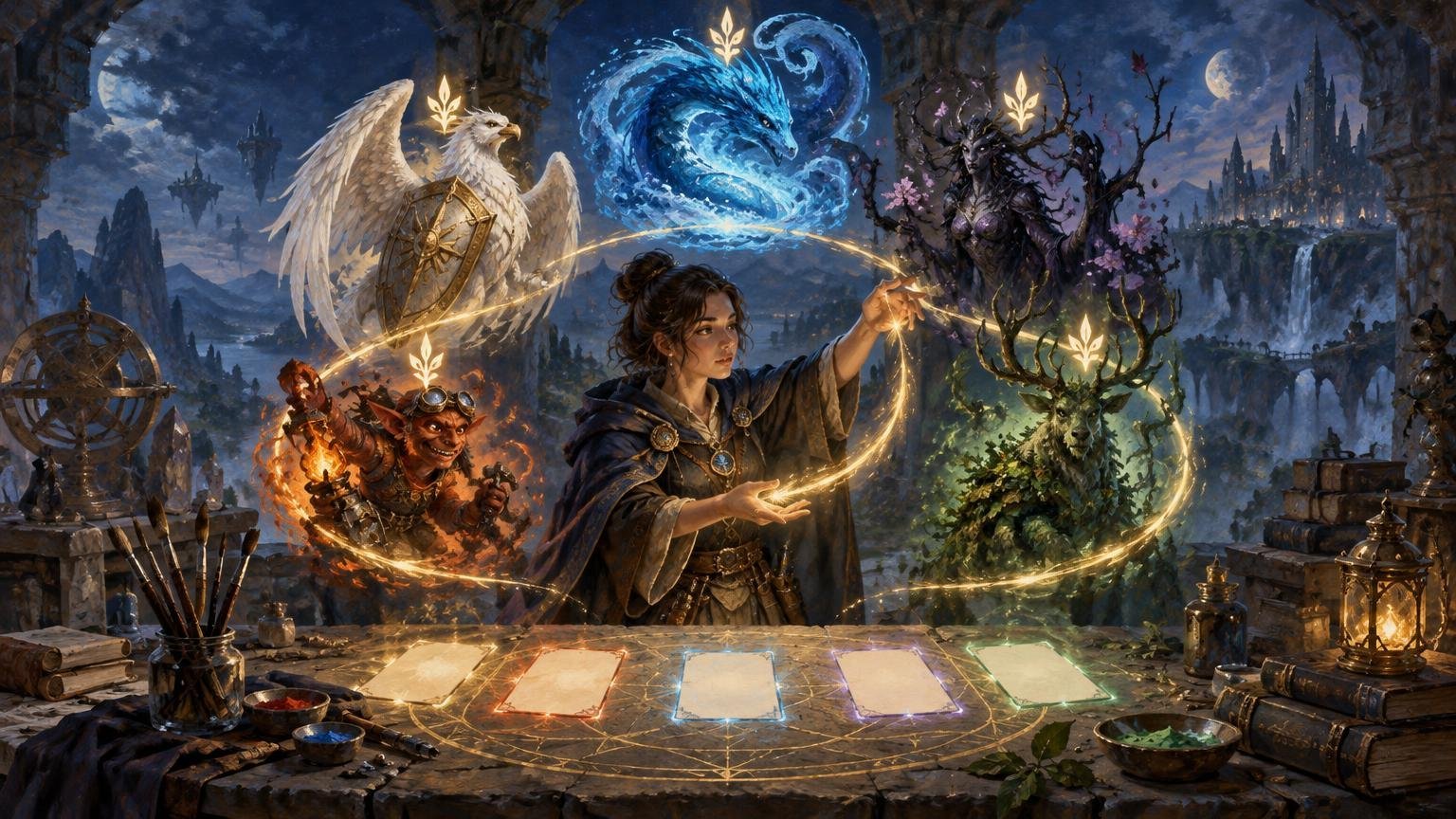
The central decision in custom MTG card cycle design is not whether five cards can share a template. It is how much they should share. A good cycle creates a moment of recognition—“this belongs with those other cards”—without making the second, third, and fourth members feel prewritten.
In Magic design usage, a cycle is a deliberately connected group that can reveal differences among similar concepts or similarities among different concepts. The connection is normally creative as well as mechanical. Related names, art direction, creature types, or repeated structure can make that relationship visible even when the cards behave differently. Wizards’ discussion of cycles and creative connections offers useful background on that role.
Before writing rules text, describe the cycle in one sentence. Not “five cool creatures” and not “one card in each color.” State the repeated structure and its purpose.
For example: “A cycle of uncommon four-mana creatures that rewards each color for advancing its Limited archetype.” That sentence establishes a number of constraints, but it does not dictate identical costs, stats, triggers, or rewards. It leaves room for each card to solve a different gameplay problem.
A useful design sentence usually identifies four things:
If you cannot explain the cycle without reciting all of its rules text, the connection may be too weak. If the sentence determines nearly every line on every card, the cycle may be too rigid.
The easiest way to control repetition is to divide the design into invariants and variables. Invariants are the features every member must share. Variables are where individual identity appears.
| Design layer | Possible invariant | Useful variation |
|---|---|---|
| Rules structure | A enters-the-battlefield ability | Each color receives a different kind of resource or interaction |
| Cost | Each card costs four mana | Colored intensity and generic mana vary by effect |
| Card identity | Each is a creature with the same class | Creature type, power, toughness, and combat role vary |
| Set function | Each supports a named mechanic | One enables it, one rewards it, one recovers its resources, and one disrupts opponents |
| Creative treatment | Parallel titles and matching composition | Different locations, moods, silhouettes, and color-specific actions |
Usually, two strong invariants are enough. A shared name pattern plus a shared trigger may communicate the cycle clearly. Locking the name, mana value, stat line, subtype, trigger, effect size, and flavor-text structure can leave too little room for good cards.
This is also why a render should come late. Matching frames and names can make an underdeveloped cycle look complete. Resolve the mechanical relationships first, then use presentation to reinforce them. When the cards reach layout, check them with the same discipline used for small-format custom-card readability.
A cycle is a constraint-heavy object. Decisions made for its first card establish expectations and can remove workable options from later members. Wizards’ set-design guidance specifically warns that designing one cycle member in isolation can leave inadequate space for the rest. Its guidance on filling a design skeleton treats cycles as set-level commitments involving color, rarity, and mechanical space.
Start with rough entries for every slot. Use functional notes rather than finished text:
Those are prompts, not formulas. The actual effects must fit the set. A graveyard-focused green-red environment may need its green member to recur a permanent while its red member rewards cards leaving the graveyard. A generic “green gets a larger creature” answer would be recognizable but less useful.
Once all slots have plausible jobs, compare them side by side. Ask whether one member owns the only exciting effect, whether two cards occupy the same gameplay role, and whether one color required an obvious color-pie bend merely to preserve symmetry. If so, change the structure instead of forcing the weak member.
A five-color cycle should normally express a shared question through five color-specific answers. Consider an uncommon cycle that rewards controlling a permanent with the set’s signature subtype. The repeated condition supplies recognition. The rewards might protect a creature in white, filter cards in blue, recur a small permanent in black, create temporary pressure in red, and add counters or mana in green.
That approach is more interesting than giving every color “When this enters, draw a card” with superficial substitutions. It also makes the cycle useful across multiple archetypes rather than producing five cards that compete for the same role.
Exact symmetry can still work when symmetry is the point. A cycle of simple dual lands, charms, or basic teaching cards may benefit from close repetition. But the designer should choose that repetition intentionally. Do not preserve a pattern merely because the first card happened to establish it.
Mana costs should also reflect the actual effects. Matching mana values can aid recognition, but equal cost does not mean equal balance. Repeatability, flexibility, immediate impact, card advantage, and board context all matter. Use a shared cost only if the resulting effects remain honest; otherwise, vary the costs or revise the cycle’s premise. The broader process in pricing custom MTG effects is useful for evaluating each member separately.
Rarity is not decoration applied after the rules are finished. It affects complexity, frequency, power expectations, and the amount of mechanical space a card occupies. A cycle at common has a different job from a mythic cycle, even if both share the same creative premise.
A horizontal cycle places related cards across colors at the same rarity. These are useful for showing how each color interacts with a set mechanic or for distributing comparable tools. They are also demanding: every member consumes a slot in its color and rarity, so the cycle must justify that footprint.
A vertical cycle connects cards within one color across multiple rarities. This can show progression, tell a small story, or reveal increasingly elaborate uses of a mechanic. The connection can become looser as rarity rises: the common teaches the action, the uncommon combines it with an archetype reward, and the rare builds around it.
Commons deserve particular care. Wizards describes common as the heart of a set and argues that a theme absent there is not meaningfully the set’s theme. Common complexity must also be assessed collectively, because several individually understandable cards can create an exhausting board when they appear together.
If your cycle appears at common, favor visible game actions, short text, and effects players can track without repeated rereading. Move the clever exception or multi-step payoff to a higher rarity rather than shrinking five dense rules boxes.
A design skeleton is a flexible planning document for mechanics, colors, rarities, and structural needs. It should change as the file changes; it is not a sacred checklist. For a broader planning framework, see how to create a custom MTG set.
Record each cycle as a set-level commitment. At minimum, track:
This catches a common failure mode: a cycle looks elegant in a separate document but damages the set around it. Five uncommon four-drops may clog the curve. Ten two-color build-arounds may consume too much gold space. A common cycle with triggered abilities may push the environment beyond its practical complexity budget.
Not every mechanic needs a complete five-card cycle. Some mechanics belong primarily in selected colors, with other colors providing support or interaction. Wizards discusses using rarity and color distribution to control as-fan—the frequency with which a feature appears when cards are viewed in Limited—and recommends testing whether that density feels right. A partial cycle can be better design than five cards created to satisfy a spreadsheet.
Two cards can use different verbs and still play identically. “Create a token,” “return a creature,” and “put a card into your hand” all differ mechanically, but if each member is simply a value-generating four-drop, the cycle may produce the same play pattern five times.
Give members different jobs. One can stabilize, one can enable a combo, one can reward attacking, one can provide recovery, and one can ask for a build-around commitment. The shared cycle structure keeps them connected while their roles create discovery.
Watch for repeated failure states as well. If every member requires an established board, the entire cycle is weak from behind. If all five generate immediate card advantage, they may dominate slower games. If every card tracks a different condition, the cycle may be mechanically varied but cognitively exhausting.
Do not polish templating while the cycle’s purpose is still unstable. Clear wording matters, but early precision can make designers reluctant to cut a bad member because it looks finished.
Once the structure survives review, compare each ability with existing Magic terminology and interaction patterns. The Magic Comprehensive Rules hub is the primary reference for detailed rules interactions and corner cases. Check trigger timing, targets, intervening conditions, duration, ownership versus control, zone changes, and whether pronouns have an unambiguous referent.
Then perform a visual pass. Parallel cards do not need parallel line counts. If one member requires substantially more text, determine whether that complexity is essential or whether the cycle is concealing a bad fit. It is usually better to loosen the pattern than to compress a complicated exception into an unreadable box.
A cycle is not balanced because its members share a mana value or because every color receives one card. Balance emerges from how those cards interact with the environment. Wizards presents design as an iterative process of building, testing, collecting feedback, revising, and testing again; a mechanic that reads well can still need substantial changes when played. Wizards’ playtesting guidance emphasizes that testing is how designers determine whether cards and mechanics work in practice.
Test in three passes:
Ask playtesters what relationship they noticed before explaining the cycle. If nobody recognizes it, the connection may need stronger names, art direction, structure, or mechanics. If players predict every unseen member after seeing one card, you may need more variation.
Collect role-specific feedback rather than asking only whether the cards were fun. Find out which cards entered main decks, which were drafted but left in sideboards, which generated rules questions, and which produced the same decision repeatedly. Those observations tell you whether to adjust individual numbers or redesign the shared structure.
The strongest cycle is not the one with the most perfect spreadsheet symmetry. It is the one whose cards clearly belong together while each still earns its own slot. Fix enough structure to create recognition, leave enough freedom for color and gameplay identity, and let the next playtest decide which connection is meaningful and which repetition is merely decorative.