
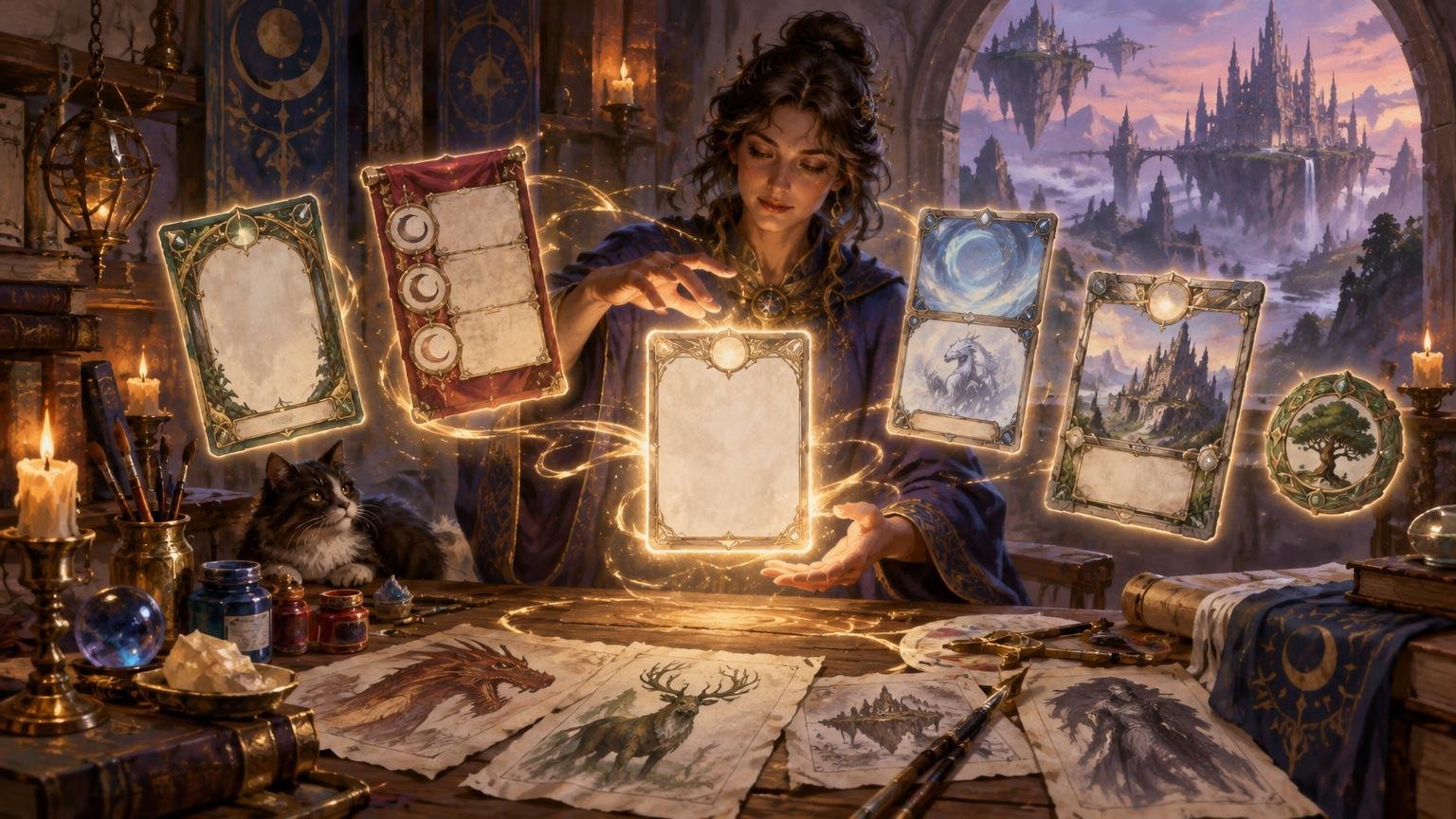
Choose a Magic card template for the information the card must communicate, not merely for its appearance. A normal single-faced frame is the best default. Use a Saga, Adventure, Battle, token, double-faced, or other specialized layout only when the design actually needs that card structure. Then proof the result at physical card size: a beautiful enlarged render can still become an unreadable game piece.
Magic’s rules do not define “template” as a game term. The Magic: The Gathering Comprehensive Rules instead identify functional card parts such as the name, mana cost, type line, expansion symbol, text box, power and toughness, loyalty, defense, legal text, and collector number. Custom-card designers use “template” more broadly for the visual layout that gives those parts a place to live.
That distinction matters. Modern, vintage, borderless, and showcase-inspired frames can present the same basic game object in different visual styles. Saga, Adventure, and Battle templates change how mechanically relevant information is arranged. Selecting an ornate frame cannot turn an ordinary enchantment into a Saga, and placing a defense box on a card does not produce a coherent Battle.
MTG.cards currently offers Modern, Vintage, Mystical Archive-inspired, and Box Topper styles. Its maker includes fields for the card name, artwork, casting cost, card type, rules text, power and toughness, frame color, and commonly used Magic symbols. These are visual creation controls, not legality or balance checks. For a closer look at how frame choices communicate color and card type, see the MTG card frame template guide.
| Template | Best fit | Main design pressure |
|---|---|---|
| Standard single-faced card | Most creatures, instants, sorceries, artifacts, enchantments, and lands | Fitting the effect into one clear rules box |
| Saga | An enchantment whose effects unfold through chapters | Making each chapter distinct, readable, and worth its place in the sequence |
| Adventure | A permanent card with a separately cast spell component | Writing two related effects without making either half cramped |
| Battle | A permanent designed around defense and defeat | Showing defense clearly and explaining the reward or transition |
| Double-faced card | A design with two substantial states or identities | Making both faces work while clearly communicating how the card changes |
| Token or helper card | A marker for a generated permanent or game information | Displaying only the information players need during play |
The ordinary frame is flexible because its hierarchy is familiar: name and mana cost first, then art, type line, rules text, and any relevant statistics. It suits most custom designs and gives the reader the fewest layout surprises.
Respect the type line. Card types, supertypes, and subtypes are separate rules categories, and subtypes appear after a long dash. “Creature — Goblin Wizard,” for example, has two creature subtypes. Do not use the type line as a second flavor-text field; every extra label can imply rules meaning.
The text box also contains different kinds of information. Rules text does mechanical work, reminder text explains a concept in italics, and flavor text supplies story or atmosphere. Ability words can connect related abilities thematically, but they have no rules meaning by themselves. When the box becomes crowded, cut complexity before shrinking the typography. The small-format readability guide explains how to test that choice at actual card size.
A Saga is appropriate when the card tells a mechanical story in stages. Its chapter abilities should feel like a sequence rather than three unrelated effects placed beside Roman numerals. Early chapters can establish resources or tension, while the final chapter provides a payoff, reversal, or conclusion.
The narrow chapter column reduces horizontal space, so long triggered abilities become difficult to scan quickly. Keep each chapter focused, repeat wording only when the repetition improves understanding, and ensure players can distinguish adjacent chapter symbols at a glance. The custom Saga design guide covers chapter timing, narrative pacing, and layout in more depth.
An Adventure layout must communicate a permanent card and its spell component without making players hunt for names, costs, or effects. The two halves should also feel related. A creature that explores, bargains, rescues, or transforms something can naturally support an Adventure spell that sets up that identity.
Treat each component as a real card-design problem. Check the Adventure spell’s rate on its own, then evaluate the later access to the permanent as part of the total value. Visually, reserve enough room for both names, both costs, the Adventure’s type line and text, and the permanent’s complete information. If either component requires dense explanatory text, the concept probably needs simplification rather than smaller lettering.
Battles introduce a defense value and a play objective that ordinary permanents do not have. The template must make that defense statistic immediately visible. The rules text must then explain what the Battle does while it remains on the battlefield and what happens when it is defeated.
Avoid treating every Battle as though it automatically follows the same play pattern. The Battle subtype carries important rules structure, so choose that structure before finalizing the frame. For custom design, ask three questions: Why would a player invest attacks or other resources into defeating this? What does the opponent gain by interfering? Is the reward strong enough to motivate the fight without making the front face irrelevant?
A token deserves its own information hierarchy. Under the Comprehensive Rules, a token is a marker representing a permanent; it is not a card even when a printed card is used to represent it. Include the name, color indicator where useful, type line, abilities, and power and toughness that players need. Omit decorative metadata that competes with gameplay information. The custom token maker guide provides a focused workflow.
Double-faced layouts work when each face needs substantial independent space. They also create practical requirements: players must understand the transition condition, recognize the current face, and handle hidden information appropriately. A cramped single face is sometimes evidence that the concept needs two faces, but transformation should serve gameplay rather than rescue an undisciplined first draft.
Borderless and art-forward templates change emphasis rather than card rules. They are effective when the illustration can support text overlays and when contrast remains strong. If the artwork is busy behind the name, type line, or rules box, the premium treatment has made the card less usable. The full-art custom card guide explores that tradeoff.
Review the card at final physical size before printing. Check names, quantities, artwork cropping, text clarity, borders, backs, and any available proof or preview. MTG.cards notes that fulfillment output may differ from official cards in material, coating, finish, thickness, texture, and flexibility.
If you supply files to a printer, follow that printer’s requirements rather than assuming every service uses identical specifications. PrintMTG currently asks for 2.5-by-3.5-inch files, 300 dpi at final size, and 0.125 inch of bleed when art reaches the edge. The custom MTG card dimensions guide explains how trim, bleed, resolution, and safe areas affect the finished design. When a finished custom design is ready for a physical playtest copy, printmtg.com provides a relevant next step.
A convincing template does not make a card authentic, balanced, rules-valid, or legal in sanctioned play. Those are separate questions. Wizards’ published proxy policy says sanctioned-event cards must be authentic Magic cards, apart from narrow circumstances in which a judge issues a replacement for a card damaged during that event.