
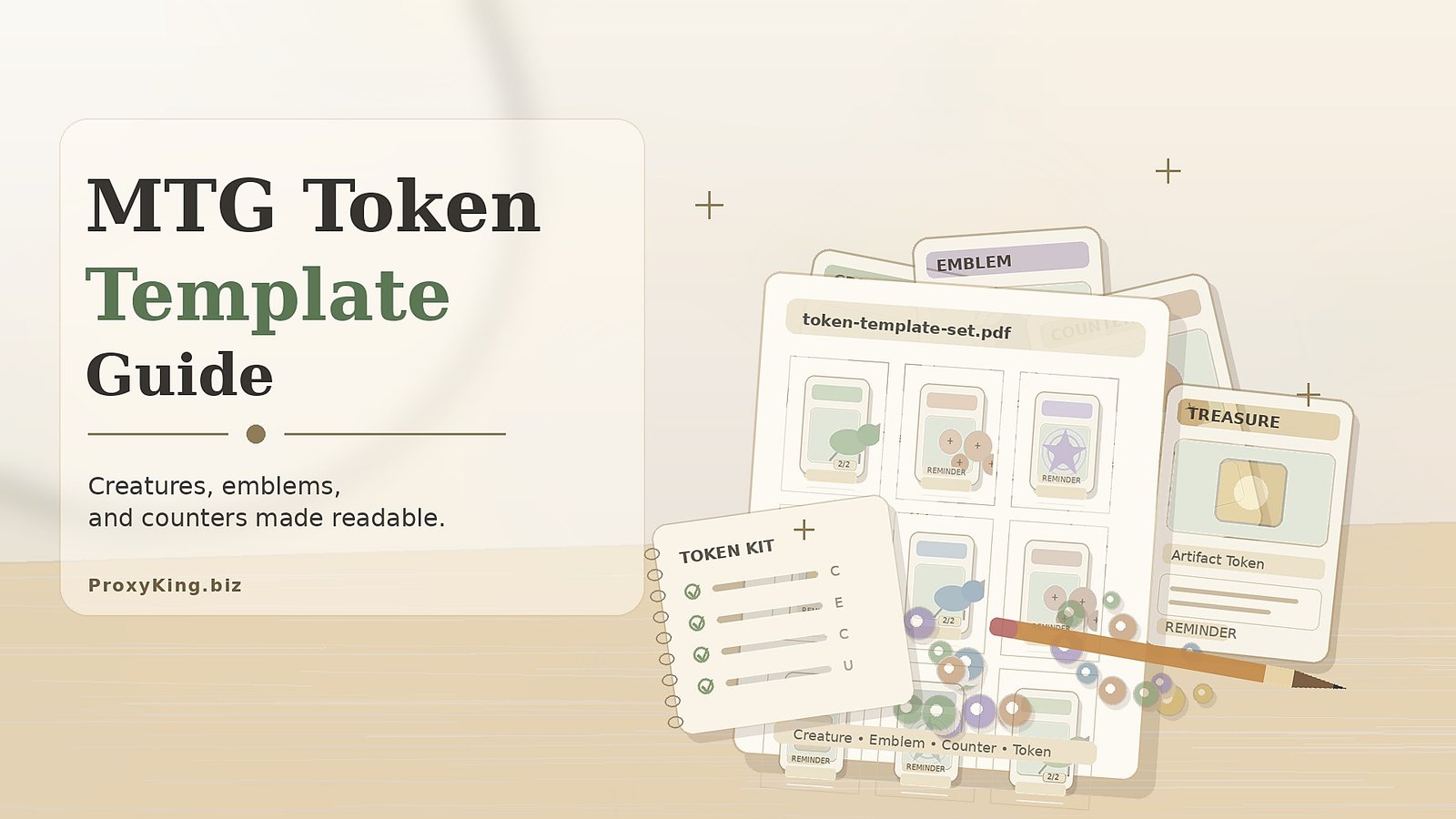
An MTG token template should make the game easier to read, not turn your board into a tiny administrative department.
Creature tokens need name, color, type, power/toughness, and abilities. Emblems need source, owner, and effect text. Counter templates should explain what the counter tracks and where it goes.
Use token templates for Commander, cube, custom cards, fan-made cards, and playtesting. Keep them clear, standard-sized, and obviously unofficial.
An MTG token template is useful because Magic creates a lot of game pieces that are not regular cards. Creature tokens, Treasure, Clues, Food, emblems, +1/+1 counters, poison counters, shield counters, stun counters, loyalty counters, experience counters, and whatever new tiny bookkeeping object shows up next set. Magic is a strategy game, but occasionally it becomes a craft table with stack interaction.
A good token template keeps the board readable. It tells players what the object is, what it does, who controls it, and whether it is a creature, emblem, counter, or reminder piece. That matters more than making it look dramatic. Nobody needs a full oil painting for a 1/1 Soldier token if the power and toughness are impossible to find.
If you want a broader look at token basics, ProxyKing’s overview of MTG tokens is a useful starting point for understanding how tokens and emblems function as game aids.
A good token template has one job: reduce friction during play.
It should answer these questions quickly:
What is this game piece?
Who controls or owns it?
Is it a creature, artifact, enchantment, emblem, or counter reminder?
Does it have power and toughness?
Does it have keywords or abilities?
What card created it?
How many copies may the deck need?
The template does not need to be beautiful. It needs to be readable. If it is both, wonderful. If it is only one, choose readable. Your playgroup will forgive plain design faster than they will forgive a token that looks like a tarot card and explains nothing.
Most Magic-style token templates should use the same size as a standard trading card:
2.5 inches wide
3.5 inches tall
750 x 1050 pixels at 300 DPI
1500 x 2100 pixels at 600 DPI
That size fits normal deck boxes, sleeves, and token storage. It also makes tokens easy to shuffle into a token stack without needing a separate furniture plan.
You can also use half-size or mini tokens for counters and reminders, but full-size templates are usually easier to read. For Commander especially, the board state gets crowded fast. If your tokens are too small, players will either ignore them or ask what they are every turn. Neither is elegant.
Creature tokens need more information than most other tokens because they interact with combat, removal, board wipes, sacrifice effects, anthem effects, and creature type synergies.
A good creature token template should include:
Token name
Color
Card type
Creature subtype
Power and toughness
Keyword abilities
Rules text, if any
Source card, if useful
Quantity marker, if useful
A clean creature token might look like this:
Name: Zombie Token
Color: Black
Type: Token Creature, Zombie
Power/Toughness: 2/2
Text: None
Source: Created by several black spells and abilities
That is enough. It does not need tragic flavor text about the Zombie’s unfinished errands.
Use a familiar card structure:
Name at top
Color indicator or frame color
Art or icon space
Type line
Rules text box
Power/toughness box
Optional source note in footer
For common creature tokens, make the power/toughness large. Combat math is already enough of a group project.
A creature token template should make these elements obvious:
| Field | Why It Matters |
|---|---|
| Name | Helps identify the token quickly |
| Color | Matters for protection, removal, and card effects |
| Type and subtype | Matters for tribal synergies and creature effects |
| Keywords | Flying, vigilance, haste, lifelink, menace, and similar abilities need to be visible |
| Power/toughness | Needed for combat and damage |
| Source | Useful when several cards make similar but not identical tokens |
If you are making tokens for an existing deck, check the exact token wording through Scryfall’s token search, which lists token entries and related printings.
Most Commander and cube decks do not need every token in Magic. They need the tokens their cards actually make. Revolutionary concept, I know.
Common creature token templates include:
1/1 white Soldier
1/1 white Spirit with flying
2/2 black Zombie
1/1 red Goblin
3/3 green Beast
1/1 green Saproling
1/1 colorless Thopter artifact creature with flying
2/2 green Wolf
4/4 red Dragon with flying
Copy token
For cube, keep the token set lean and organized. For Commander, make duplicates for any token the deck creates repeatedly. One Zombie token is cute. Twenty Zombies represented by one card and a d20 is functional. Twenty different dice balanced on sleeves is how a board state becomes a small landslide.
Not every token is a creature. Some of the most common tokens in modern Magic are utility tokens:
Treasure
Clue
Food
Blood
Map
Powerstone
Gold
Shard
Junk
These templates need less space than creature tokens because they usually do not attack or block. For these, make the token name and activated ability easy to read.
A Treasure token template should clearly say that it is an artifact token and show the sacrifice ability for mana. A Clue should show its draw ability. A Food token should show its life-gain ability. Do not assume everyone remembers every token’s exact text. Magic players remember 14,000 cards and still ask what Food does. This is normal. Probably.
Emblems are different from tokens. A token usually represents a permanent on the battlefield. An emblem represents a continuing game effect, usually created by a planeswalker or specific card ability. Emblems are not regular permanents sitting on the battlefield, and they are usually much harder for players to interact with directly.
That means an emblem template should focus on clarity over decoration.
An emblem template should include:
Emblem name
Source card
Player who has the emblem
Full effect text
Any timing reminder
Version or date, if custom
A clear “Emblem” label
Example:
Name: Chandra Emblem
Source: Chandra, Awakened Inferno
Owner: You
Text: At the beginning of your upkeep, this emblem deals 1 damage to you.
That is the type of reminder players need. Emblems can be game-defining, and they tend to stick around. A vague emblem template is not mysterious. It is just bad paperwork.
For official rules context, Wizards keeps the current Magic Comprehensive Rules on its Magic rules page, which is the best place to check rules questions involving tokens, emblems, and counters when casual memory starts doing its usual little tap dance.
Emblem templates do not need power/toughness, mana cost, or a normal type line. They need effect text and ownership clarity.
A clean emblem layout could include:
Large “Emblem” heading
Source card name under the heading
A full-width rules text box
Owner line
Optional planeswalker icon or color stripe
No power/toughness box
Good emblem design is boring in the correct way. The effect text should be the star. If the emblem’s art is so busy that nobody can read the upkeep trigger, the art has won the wrong contest.
Counters are not tokens. They are markers placed on players, permanents, cards, or other objects depending on the effect. This matters because a +1/+1 counter on a creature is not a creature token. A poison counter on a player is not an emblem. A loyalty counter on a planeswalker is not a tiny motivational sticker, although that would be charming.
Counter templates are usually reminder cards, not the counters themselves. The actual counters are often dice, beads, glass stones, or small markers.
A counter template should explain:
Counter name
Where it is placed
What it does
How it is represented physically
What cards or mechanics use it
Whether it applies to a player, permanent, or card
Example:
Name: Poison Counter Reminder
Goes On: Player
Reminder: A player with ten or more poison counters loses the game.
Use With: Infect, toxic, poison effects
That reminder is much more useful than a vague card that just says “Poison” in cool letters. Cool letters do not answer rules questions. They only make them more stylish.
A good counter template kit might include:
+1/+1 counter
-1/-1 counter
Loyalty counter
Charge counter
Shield counter
Stun counter
Finality counter
Keyword counter
Poison counter
Experience counter
Energy counter
Time counter
Oil counter
Defense counter
Lore counter
You probably do not need all of these unless your deck is doing something deeply committed to counters. Start with the counters your deck actually uses.
A deck with proliferate wants more counter reminders. A planeswalker deck wants loyalty support. A toxic deck wants poison tracking. A Saga-heavy deck may need lore counters. A normal creature deck probably does not need a custom “spite counter” unless your group has lore issues.
Counter reminder templates should be simple and bold.
Use:
Counter name at top
Icon or symbol area
Short rule reminder
“Placed on” line
Tracking space or number area
Source card note, if needed
For example:
Shield Counter
Placed on: Permanent
Reminder: If it would be dealt damage or destroyed, remove a shield counter instead.
That is clean. It tells players what to do. It does not require anyone to open six browser tabs mid-combat, which is generally considered a luxury.
Creature tokens and counters are often confused by newer players because both can be represented by physical objects. The difference is important.
| Game Piece | What It Represents | Example |
|---|---|---|
| Creature token | A creature permanent | 2/2 Zombie |
| Utility token | A noncreature token permanent | Treasure |
| Emblem | A continuing game effect tied to a player | Planeswalker emblem |
| Counter | A marker placed on something | +1/+1 counter, poison counter |
| Reminder card | A printed aid for tracking | Token reference, counter note |
This is the core design lesson: make the template match the job. Do not use a creature-style frame for a counter reminder. Do not use an emblem layout for a Treasure token. Do not make every card-shaped object look identical unless you enjoy slowing the game down for sport.
Use this framework when deciding how polished your templates need to be.
Good: The template is readable and has the required game information.
Better: The template is readable, standard-sized, and visually distinct by token type.
Best: The template is readable, standard-sized, visually distinct, durable enough for repeated play, and organized by deck or cube.
For a quick test game, “good” is enough. For a Commander deck you play every week, “better” is worth it. For a cube that multiple people draft, “best” starts to matter because other players need to understand the cards without your personal commentary track.
For Commander, build token templates around your actual deck.
Step one: review the decklist.
Step two: identify every card that creates tokens, emblems, or counters.
Step three: list each unique game piece.
Step four: decide how many physical copies you need.
Step five: print or create the templates.
Step six: store them with the deck.
A Commander token kit might include:
10 Treasure tokens
8 creature tokens
3 copy tokens
2 emblem reminders
1 poison reminder
1 experience counter reminder
1 monarch or initiative reminder
If your commander creates the same token constantly, make extra copies. If your deck creates one weird token once every seven games, one template is fine. There is no trophy for carrying an entire filing cabinet of unused Goblins.
Cube token templates need to be consistent and easy for guests to use.
For cube, prioritize:
Uniform size
Clear labels
Multiple copies of common tokens
A storage system by color or type
Simple art
Readable abilities
No deck-specific shorthand
Cube players may not know your environment. They should not need to ask whether the green Saproling token is actually a Plant because your template uses a decorative mushroom and no type line. Give them the information. Let them spend their energy drafting badly like the rest of us.
For home printing, use standard card size and a 3-by-3 sheet layout. Print on paper, cut the tokens, and sleeve them with bulk cards if you want them to feel like normal cards.
For more durable token cards, use heavier paper or a print service. If you are already preparing custom proxy or playtest cards, ProxyKing’s Proxy Use Policy is a helpful boundary marker for casual use, table transparency, and avoiding misrepresentation.
Printing checklist:
Use 2.5 x 3.5 inch card size.
Use 300 DPI minimum.
Keep text inside the safe zone.
Use simple icons and clear labels.
Make power/toughness large on creature tokens.
Use different layouts for tokens, emblems, and counters.
Print a test page before printing a full token set.
Store tokens with the deck that needs them.
This is not glamorous work. But it makes games smoother, and smoother games mean fewer arguments about whether that blue die was a Clue, a stun counter, or someone’s snack accountability system.
A token system only works if you can find the token when you need it.
Good storage options include:
Small deck box section
Side pocket in Commander deck box
Token binder page
Color-coded dividers
Tiny labeled envelopes
Cube token station
Plastic card case
For Commander, store tokens with the deck. For cube, keep all tokens in one central location. For counter reminders, keep them with dice or markers.
A token you cannot find is not a token. It is a rumor.
Before using your template, check:
The token name is clear.
The type line is accurate.
Creature tokens show power and toughness.
Ability text is readable.
Colors are easy to identify.
Emblems show source and owner.
Counter reminders explain what the counter does.
Templates fit standard sleeves if printed.
The design is clearly unofficial if custom.
Your playgroup understands what the templates represent.
If the template passes those tests, it is ready for casual play.
A creature token template should include the token name, color, type and subtype, power/toughness, keyword abilities, rules text if needed, and optionally the source card that creates it.
An emblem template tracks a continuing effect tied to a player, often from a planeswalker. It does not need power/toughness or a normal creature-style layout. It should show the source card, owner, and full effect text.
No. Tokens are game objects, often permanents. Counters are markers placed on players, permanents, or other objects. A printed counter template is usually a reminder aid, not the counter itself.
Most token templates should use standard trading card size, about 2.5 inches by 3.5 inches. This makes them easy to sleeve, store, and use with Commander decks or cubes.
Yes, in casual Commander. Custom token templates are common and helpful as long as they clearly represent the correct game pieces and do not confuse the table.
No. Players can use many kinds of clear markers for tokens and counters in casual play. Official token cards are convenient, but readability and agreement matter most at the table.